So,

We won't use flowery words for this blog, so basically, this will be a simple blog which contains a summary of the summaries of information about the Renaissance period.

Linggo, Disyembre 13, 2015

Industrial Revolution Inventors

James Hagreaves
Biography: James Hargreaves was a weaver, carpenter and inventor in Lancashire, England. He was one of three inventors responsible for mechanising spinning.

Inventions: Spinning Jenny


John Kay

Biography: John Kay was the inventor of the flying shuttle, which was a key contribution to the Industrial Revolution. He is often confused with his namesake, who built the first "spinning frame".

Inventions: Flying Shuttle


Samuel F. B. Morse
Biography: Samuel Finley Breese Morse was an American painter and inventor. After having established his reputation as a portrait painter, in his middle age Morse contributed to the invention of a single-wire telegraph system based on European telegraphs.

Inventions: Telegraph


Alexander Graham Bell


Biography: Alexander Graham Bell was a Scottish-born scientist, inventor, engineer and innovator who is credited with patenting the first practical telephone.

Inventions: Telephone


John Loudon McAdam
Biography: was a Scottish engineer and road-builder. He invented a new process, "macadamisation", for building roads with a smooth hard surface, using controlled materials of mixed particle size and predetermined structure, that would be more durable and less muddy than soil-based tracks.
Inventions: Road building


Thomas Telford
Biography: Thomas Telford FRS, FRSE was a Scottish civil engineer, architect and stonemason, and a noted road, bridge and canal builder.

Invention: Canal builder


Wilbur and Orville Wright
Biography: were two American brothers, inventors, and aviation pioneers who are credited with inventing and building the world's first successful airplane and making the first controlled, powered and sustained heavier-than-air human flight, on December 17, 1903. From 1905 to 1907, the brothers developed their flying machine into the first practical fixed-wing aircraft.

Inventions: Airplane


Henry Bessemer
Biography: Sir Henry Bessemer was an English inventor whose steelmaking process established the town of Sheffield as a major manufacturing centre.

Inventions/Discovery: Steel-making


Thomas Edison
Biography: Thomas Alva Edison was an American inventor and businessman. He developed many devices that greatly influenced life around the world, including the phonograph, the motion picture camera, and the long-lasting, practical electric light bulb.

Invention: Practical light bulb


George Stephenson
Biography: George Stephenson was an English civil engineer and mechanical engineer who built the first public inter-city railway line in the world to use steam locomotives, the Liverpool and Manchester Railway which opened in 1830

Invention: Railroad

Biyernes, Disyembre 4, 2015

Enlightenment Period

Jean-Jacques Rousseau
Biography: was a philosopher, writer, and composer of the 18th century. His political philosophy influenced the Enlightenment in France and across Europe, as well as aspects of the French Revolution and the overall development of modern political and educational thought.

Discovery: Original man, in his natural state, was entirely free and virtuous.

Legacy: Social contract theory


John Locke
Biography: John Locke FRS was an English philosopher and physician regarded as one of the most influential of Enlightenment thinkers and known as the "Father of Classical Liberalism"

Discovery: We acquire ideas through our experience of the world.

Legacy: Human Rights

Rene Descartes
Biography: René Descartes was a French philosopher, mathematician, and scientist. Dubbed the father of modern philosophy, much of subsequent Western philosophy is a response to his writings, which are studied closely to this day 

Discovery: Nature of existence and of knowledge 

Legacy: Logic 

Charles Montesquieu
Biography: Charles-Louis de Secondat, Baron de La Brède et de Montesquieu, generally referred to as simply Montesquieu, was a French lawyer, man of letters, and political philosopher who lived during the Age of Enlightenment.

Discovery: The government should be the one to protect the freedom of the people

Legacy: Non-despotic Government

Voltaire
Biography: French Enlightenment writer, historian, and philosopher famous for his wit, his attacks on the established Catholic Church, and his advocacy of freedom of religion, freedom of expression, and separation of church and state.

Discovery: The state should be separated from the church

Legacy: "Candide"

Huwebes, Disyembre 3, 2015

Scientists during the Scientific Revolution

William Harvey
Biography: William Harvey was born in Folkestone, Kent on 1 April 1578. His father was a merchant. Harvey was educated at King's College, Canterbury and then at Cambridge University. He then studied medicine at the University of Padua in Italy, where the scientist and surgeon Hieronymus Fabricius tutored him.

Discovery: Blood circulates through our whole body.

Legacy: Map of circulatory system


Galileo Galilei
Biography: Galileo Galilei, was an Italian astronomer, physicist, engineer, philosopher, and mathematician who played a major role in the scientific revolution during the Renaissance.

Discovery: Universal law of Acceleration

Legacy: Telescope

Nicolaus Copernicus
Biography: Nicolaus Copernicus was a Renaissance mathematician and astronomer who formulated a model of the universe that placed the Sun rather than the Earth at the center of the universe. 

Discovery: Earth is not the center of the universe, instead, it was the sun and the planets revolve around it.

Legacy: Heliocentric Theory

Isaac Newton
Biography: Sir Isaac Newton PRS was an English physicist and mathematician who is widely recognised as one of the most influential scientists of all time and as a key figure in the scientific revolution.

Discovery: The greater the mass, the higher the pull of gravtiy

Legacy: Newton's Law of Gravity


William Gilbert
Biography: William Gilbert, also known as Gilberd, was an English physician, physicist and natural philosopher. He passionately rejected both the prevailing Aristotelian philosophy and the Scholastic method of university teaching.

Discovery: Not only amber was capable of manifesting electrical properties.

Legacy: Electrical Science

Linggo, Nobyembre 22, 2015

Explorers of European Expeditions

Spain:

Name: Francisco Vasquez de Coronado
1510-1554
Place of Birth: Salamanca, Spain
Biography:
        He was born in Salamanca, Spain and went to the Americas in 1535 when he was 25. His first appointment was as assistant to the Viceroy of New Spain, Antonio de Mendoza.
Legacy:
        Visited New Mexico and other parts of the southwest to which is now the United States.

Name: Hernan Cortes de Monroy y Pizarro
1485-1547
Place of Birth: Medellin, Spain
Biography:
        Hernan Cortes was born around 1485 in Medellin Spain, and helped in advancing Spain's position in North America in the 1500s. He came from a lesser noble family in Spain. Some reports indicate that he studied at the university of Salamanca for a time.Portugal.
Legacy:

        He conquered the Aztecs.


Name: Vasco Nuñez de Balboa
1475-1513
Place of Birth: Jerz de los Caballeros, Spain
Biography:
             Balboa was born in 1475 in Jerez de los Caballeros, a town in the impoverished Extremadura region of Spain. His father was believed to be a nobleman, but the family was not wealthy; like many of his class, Balboa decided to seek his fortune in the New World.
Legacy:
         Helped establish the first settlement on the South American continent at Darien at the coast of Isthmus in Panama.


Name: Gonzalo Pizarro
1510-1548
Place of Birth: Trujillo, Cacares, Spain
Biography:
        Was the brother of Hernando Pizarro, Juan Pizarro and Francisco Pizarro. The four of them went together in an expedition to Peru.
Legacy:
        Helped in conquering Peru and executing its leader along with his brothers.

Name: Juan de la Cosa
1460-1510
Place of Birth: Santoña, Spain
Biography:
               Juan de la Cosa is also known as the 'Biscayan'. Although researchers have no exact evidences as to where de la Cosa was born, it was presumed that it was in Santoña for his wife as well as his daughter lived there,
Legacy:
        One of the first Europeans who helped in designing the map.


Linggo, Nobyembre 8, 2015

Famous Artist in Renaissance

Famous Artist of the Renaissance Period


Michelangelo Buonarroti
Buonarroti's full name is Michelangelo di Lodovico Buonarroti Simon. And as all other significant men in history, he has multiple occupations. He is a sculptor, a painter, an architect, and a poet. His most known arts are usually of those human depictions, and most often, they are nude.

David (1504)
One of Michelangelo's most famous works. David in all of his glory. David is a famous hero from biblical stories and was a favourite of the Florentines.

Pieta (1499)
Pieta is a sculpture of Virgin Mary holding Jesus Christ in her arms as he was removed from the cross. In the present, miniature types of this is being sold. It is also sometimes used in the altars of the church. 

The Creation of Adam (1512)
A painting of Adam, the very first man. This art is famous especially during the 21st century and is most used in internet posts. Some homeowners also hire painters to copy the painting and garnish their ceilings with the masterpiece. 


Leonardo Da Vinci
Leonardo is not only a painter but also an architect, mathematician, engineer, etc. He is a perfect example of a 'Renaissance Man'. It is evident that Leonardo is famous for many has made documentaries about him and his works.

Mona Lisa (1517)
Mona Lisa is one of the most famous artworks from the Renaissance period. It is a portrait of a woman named Lisa Gherardini Giocondo. A replica of the art is displayed at the Louvre museum.

The Last Supper (1498)
The Last Supper, a mural painting by da Vinci. The painting is amounts to the Gospel of John, 13:21, when Jesus Christ announced that one of his disciples will betray him. Today, replicas of this painting is displayed before dining rooms.

Virgin of the Rocks (1508)
In this painting, the elements in the art is very distinct and unusual. Virgin of the Rocks were the title of two of his artworks, the two vary only with its details. Both picture Madonna with the child Jesus, an infant John the Baptist, and an angel.


Donatello
Donato di Niccolo di Betto Bardi, better known as Donatello. He studied classical sculpture thus his Renaissance art. He uses wood, rock, bronze, clay, stucco, wax, etc.

Magdalene Penitent (1455)
The Magdalene Penitent is only one of the many arts in portrayal of Mary Magdalene. Magdalene was a prostitute before repenting in the desert for thirty years. In this art, Donatello breaks all stereotypes and made the art with Magdalene being pitifully unhealthy.

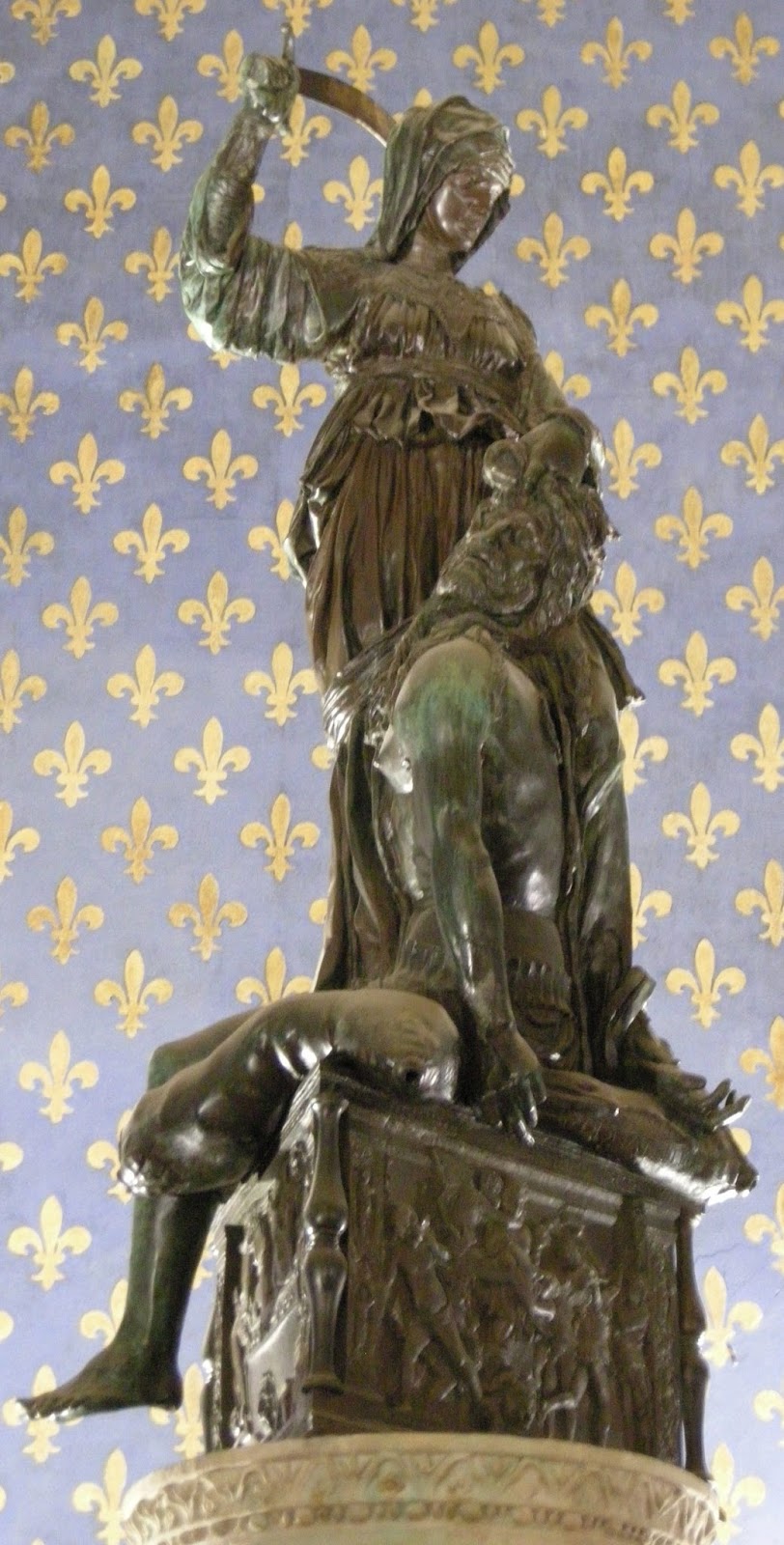
Judith and Holofernes (1460)
Donatello's representation of the assassination of the General Holofernes. The sculpture was made during the end of his career. It is one of the remarkable sculptures that were conceived in the round, with its four distinct faces.

David (1409)

 The marble David, fully clothed was made during Donatello's twenties. He was commissioned to make it though it was never displayed by the person who asked him to do it. Later in his years, he made a bronze version, one were David was unclothed.


Raphael
Raphael's full name is Raffaello Sanzio da Urbino. His father was also a painter. Raphael died early at the age of 37.

The School of Athens (1511)
This art was Raphael's best known work. It is his depiction of Philosophy. This work of his was seen as "Raphael's masterpiece and perfect embodiment of the classical spirit of Renaissance."

Oddi Altarpiece (1504)
The altarpiece of the Coronation of the Virgin. In the upper part of the painting shows Virgin Mary being crowned. In the bottom shows the apostles gathered around Mary's tomb.

The Marriage of the Virgin (1504)
Also known Lo Sposalizio. It depicts the marriage ceremony of Mary and Joseph. It was inspired by the painting of Perugino.


Titian
Tiziano Vecellio or best known as Titian is a famous painter duriing this period. His art style greatly influenced Renaissance artists and also the present Western artists. He died due to a fever.


Diana and Actaeon (1559)
This painting shows the first meeting of Diana and Actaeon. It perfectly shows the concept of Renaissance art. Body proportion and realistic expressions.

Venus and Adonis (1554)
This illustration shows the end of Venus and Adonis' relationship. Though Venus tried to stop Adonis from hunting, the man retaliated thus ending in his tragic death. You can see Cupid sleeping in the background, this symbolizes Adonis' resistance from Venus.

Rape of Europa (1562)
This painting shows Europa being carried away by a Jupiter disguised as a bull. At the bottom left of the painting, the nude boy seemed to be mocking her. The art clearly depicts Roman mythology.


Source: Wikipedia

Admins

The Admins


Czar

Raimcelle Batucan

Chancellor

Aron Belarmino

Philosophers


Bryan Chekim


Cha Hyun Woo


Rade Villarte


Kate Seville